
Explaining OBSESSION's Estimated Waterfall.
To understand feature film recoupment a little better.

If you’re in the film industry and you’ve been online the last couple of days, you’ve probably seen the debate that has been going on around Obsession, sparked by the art director for the movie through an Instagram post.
If you haven’t, here’s an article that summarises things.
Today, I’m not here to comment on the situation itself, that’s a whole other topic worthy of its own newsletter, but something really interesting came out of it, also on Instagram, that didn’t go as viral, so I thought I’d share it here.
Producer Mynette Louie made a post breaking down her estimated recoupment waterfall for the film, just as she wanted to acknowledge some of the wrong math that was going around regarding the film’s profitability.
From Mynette Louie:
You guys, I cannot take any more of the incorrect info and assumptions about #Obsession math! So here's my public service to everyone: a decent approximation of the waterfall based on my 2 decades of indie #producing. (Note: Focus took US rights and only some international, so I'm only including USBO to date.) You're welcome!
UPDATE: I forgot to include box office and TVOD bonuses, though those can range very widely. But the team probably got them given the bidding war situation at TIFF. That seller's leverage is also why I thought a 30% distribution fee and 75% share of net was not out of the realm of possibility (and besides, I want you filmmakers to get the most you can from distributors, so think about these numbers aspirationally!). For one of my films that was in a bidding war situation, the distribution fee landed at 35% and our share of net at 100%! Also, please remember these numbers are pure speculation, an educated guess at what the waterfall may kinda sorta look like. Do NOT quote any of this as fact!
As said above, I’m also only sharing this because it’s really interesting to get an idea of how box office waterfalls down to the producers, however all of this is - at the end of the day - an estimate. It also doesn’t include VOD or international distribution, so the final Gross and Net numbers for the film are definitely a lot higher.
Here is the graph:
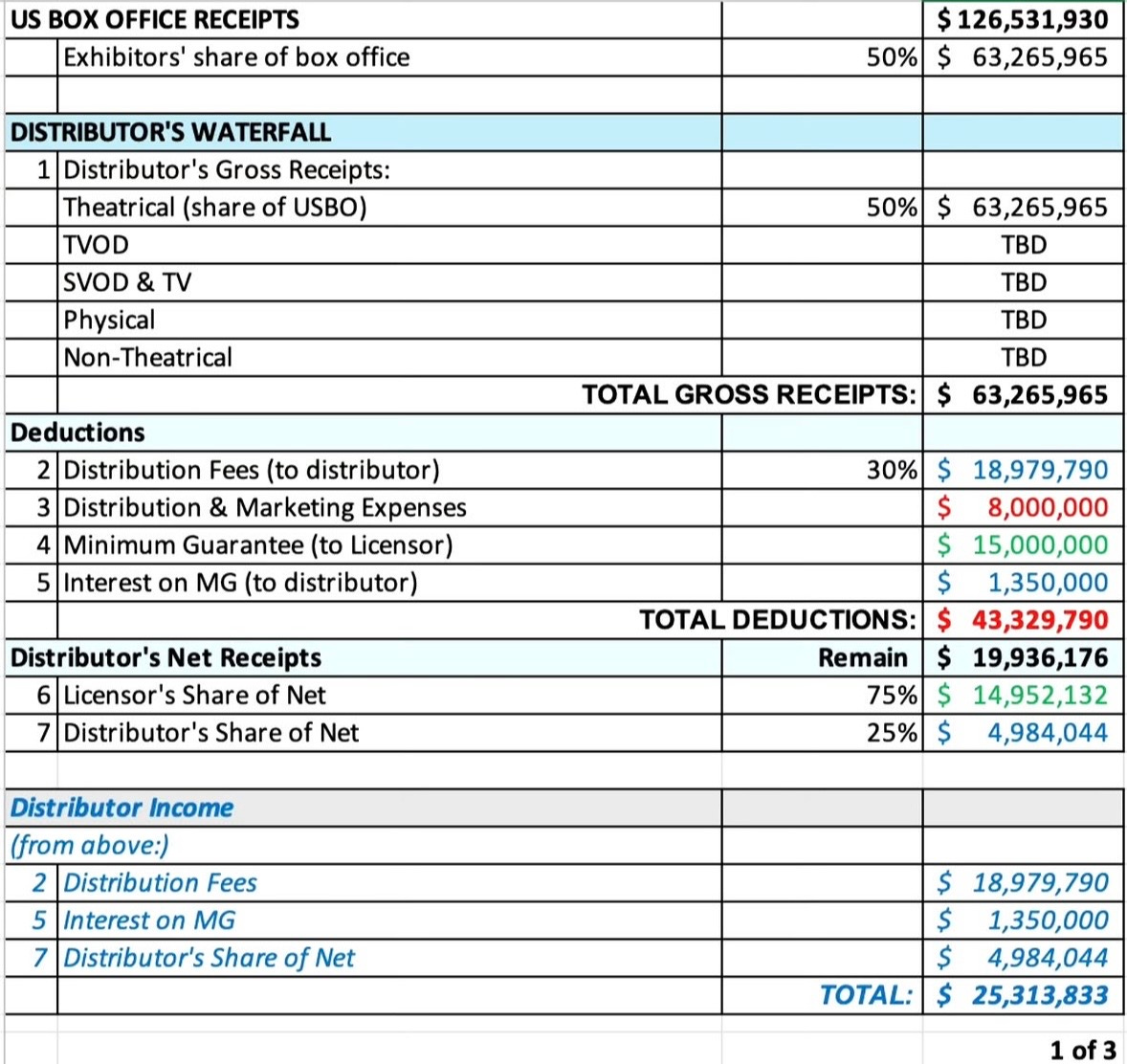
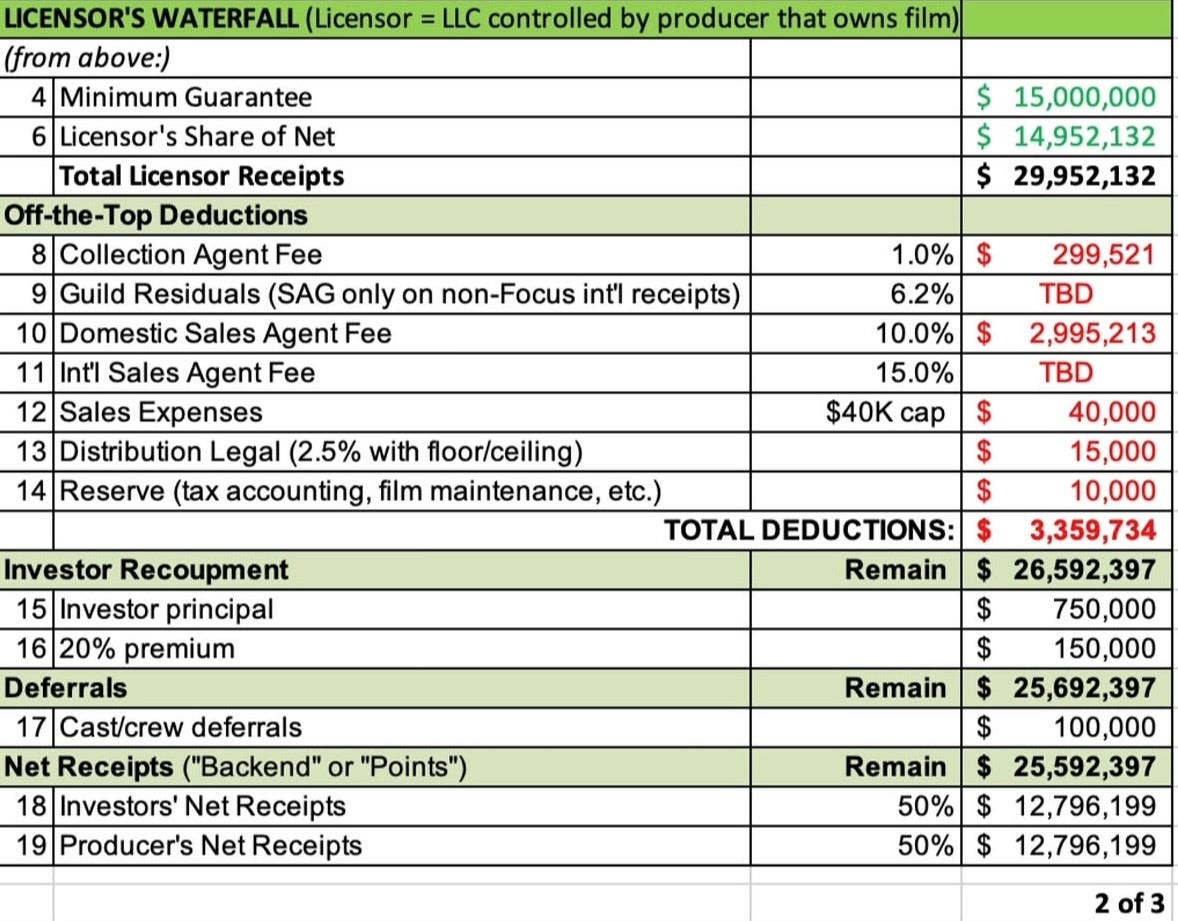
Here is it broken down:
1 is total Gross, this is all the money the film made, excluding the exhibitor %, so what the cinemas keep essentially.
2 is the fees the distributor takes off the Gross first, think of this as a commission basically, this is their fee for working on the film.
3 is the money the distributor put up front for marketing, which they recoup off the Gross as well.
4 is the initial MG that was paid to the filmmakers for the rights of the film.
5 is what the distributor takes off the Gross because they’ve paid the MG ahead of time; basically this means, we paid you £15M for the rights, so we take a little percentage of the Gross because we gave you what’s essentially an advance.
6 is filmmakers’ percentage remaining, post recoupment of all above.
7 is distributor’s percentage remaining, post recoupment of all above. I personally think the Net split is likely more in the favour of the distributor because of how high the MG is and because of how small the film was to begin with. But Mynette knows way more about recoupment than me, so I might be wrong!
Then there’s a little breakdown of the total remaining in favour or both the filmmakers and the distributor, after which we breakdown the filmmakers’ remaining alone:
8 is a % for the collection agent, which is the company that essentially distributes all these finances to the correct parties in the correct way.
9 is TBD, so we don’t worry about it in this graph.
10 is the % the sales agent takes for facilitating the sale.
11 is TBD, so we don’t worry about it in this graph.
12 is the money the sales agent put upfront for facilitating the sale, their own expenses, which they recoup now.
13 and 14 are essentially miscellaneous financing expenses.
15 is the repayment of the initial budget to the investor(s).
16 is the premium the investor gets for putting the money in; they say essentially, I’ll fund the film, but I want my investment recouped first, and then another 20% before any profit trickles down to you.
17 is any payments that cast/crew agreed to receive as a late flat fee, after the film was sold, for their work on the film to begin as it was shooting / in post. I don’t actually believe Obsession had many deals as such, so I personally don’t think this number is as high. But again - Mynette knows more than me in these cases!
18 is the final Net that goes to the Investor(s), after repayment to their initial investment and any premium.
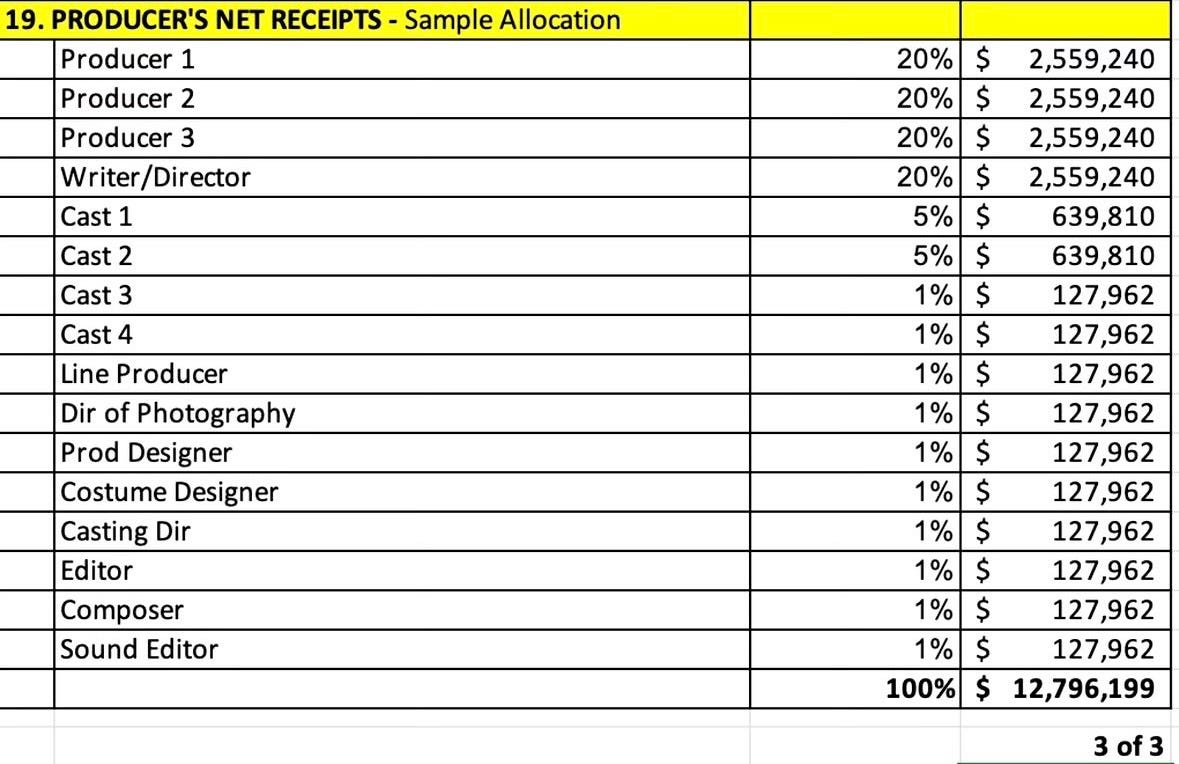
19 is what the filmmakers / production company keeps. The rest is a breakdown of how that could be redistributed to the internal team specifically.
From £126M down to £12M. Pretty good money of course, to say the least, but I think the graph above is so helpful to understand where the other £114M goes. Also, as mentioned by Mynette - this entire breakdown is only for domestic Box Office. Everyone involved has a lot more money coming in from international distribution, licensing deals, merchandise, etc. No one, at least on the business side of Obsession, is struggling at the moment!
We have a longer guide (that’s slightly outdated) that looks at this in way less mathematical detail, but with a little more industry insight. That’s completely free and linked here.
We also have a webinar coming up, which is on feature film revenue streams, which looks things like what’s above, but also TVOD deals, streaming, product placement, and more. That’s ticketed and linked here.
I hope this was helpful!